“Berlino fa i suoi interessi. E continuerà a farlo”

Intervista di Cinzia Sciuto, MicroMega+, Gennaio 28, 2022.

La Germania dopo il lungo cancellierato di Angela Merkel e il suo ruolo nell’Ue. L’analisi del sociologo tedesco: “Non ci saranno modifiche ai Trattati. I Paesi che soffrono dell’unione monetaria dovrebbero pensare a come liberarsene invece di sperare in compensazioni da parte dei Paesi che ne beneficiano”.

Dopo 16 anni al potere, dall’8 dicembre scorso Angela Merkel non è più cancelliera. Quali sono stati i momenti più significativi del suo cancellierato, quali gli errori più gravi?

Questa è una domanda per rispondere alla quale servirebbero uno o due libri! Angela Merkel è stata molto abile far passare come interesse europeo l’interesse nazionale tedesco nel preservare l’unione monetaria. È riuscita a far passare l’unione monetaria di Kohl e le riforme neoliberali di Schröder come merito suo. Allo stesso tempo, con le politiche di bilancio dei suoi governi, ha accettato il decadimento ormai avanzato dell’infrastruttura tedesca. (…)

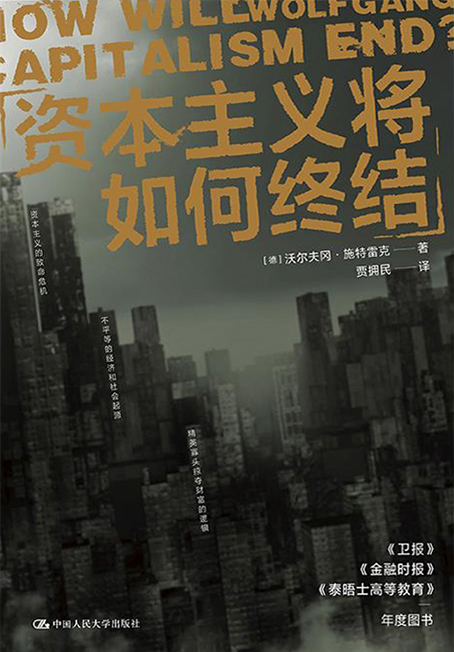
书籍翻译 – 资本主义将如何终结 (Book translation – How Will Capitalism End?)

Chinese translation: How Will Capitalism End? Essays on a Failing System (Beijing: China Renmin University Press 2021).

本书出自享誉世界的当代政治和经济问题专家沃尔夫冈·施特雷克之手。在书中,施特雷克认为世界即将发生巨变。民主与资本主义的联姻行将步入坟墓——这本来就不是一场门当户对的婚姻,注定要反目的双方,当初是在第二次世界大战的阴影下勉强结合在一起的。曾经对金融行业的过度扩张起到了一定限制作用的监管机构已经崩溃;在冷战结束之后,资本主义似乎取得了最后的胜利,然后就再也没有任何政治机构能够逆转市场的自由化了。
在沉沦于不健康状况多年之后,资本主义现在正式进入紧急状态。增长已经让位于停滞,不平等导致了不稳定,民众对货币经济的信心也消失殆尽。资本主义世界面临不断下降的经济增长率、愈演愈烈的寡头统治、日益萎缩的公共领域、病入膏肓的制度性腐败和没有尽头的国际无政府状态,最关键的是,目前还看不到治愈这些疾病的方法。

更多信息见中国人民大学出版社网站(链接

Absent Without Leave: The European Union in the Corona Pandemic

In: Ordines – Per un sapere interdisciplinare sulle istituzioni europee, 7 (2021) 2, 20-31.

ABSTRACT – How did the European Union respond to the Covid-19 pandemic? The first part of the paper analyzes the logic of the EU’s multi-level politics as it relates to the relationship between national and supranational decision-making in an international emergency. Attempts on the part of the EU to increase its powers largely failed while member states were essentially left to their own devices, also due to the uncertainty of the situation and the diversity of local conditions and preferences. The second part deals with the apparent absence of the EU in the global politics of “biosecurity”, which is largely dominated by the United States, its global pharma industry and, to an impressive extent, by the U.S. military establishment. In this context, the paper summarizes the present state of the international discussion on the origin of the new coronavirus and on the virological research conducted, among other places, at the Wuhan virological laboratory.

In the Superstate

Review of Christopher J. Bickerton and Carlo Invernizzi Accetti (2021), Technopopulism: The New Logic of Democratic Politics, Oxford: Oxford University Press.

Appeared in London Review of Books, 44 (2), January 2022.

By and large,​ we know what we mean by technocracy: the delegation of public authority to an elite cadre with some sort of scientific expertise, their legitimacy derived from their superior knowledge. In a technocracy, decisions can be challenged only by other experts. Everyone else must sit back and watch.

It’s less clear what we mean by populism, since the term is used for so many different things. Most current definitions share the idea of a ‘people’ divided and short-changed by an ‘elite’, and who come to consciousness by pushing that elite aside, replacing it with a new leadership that has a relationship of something like mystical unity with ‘the people’. Populism, on the left and the right, promises a social unity achieved through politics and the state, overcoming division by eliminating the enemies of the common people – the capitalists in left populism, non-nationals of various sorts in the populism of the right. While elite rule divides the people into self-seeking factions, populism unites them, in a struggle against those who claim to know better than the masses what the masses need. (…)

Continue reading on lrb.co.uk

Letter from Europe: Ultra Vires

Sidecar, January 7, 2022.

Remember the campaign, conducted by the European Commission (EC) and the EU Parliament (EP) with the help of the Court of Justice (CJEU), to teach Poland the rule of law by withholding its share in Ursula von der Leyen’s precious, the Next Generation EU (NGEU) Corona Recovery Fund? EU legalese being not by accident notoriously difficult to understand for anyone but the Court itself, hard thinking reveals that ‘rule of law’ means two things here: independence of the national judiciary from the national executive, and recognition by both of the supremacy of European over national law, including national constitutional law, whatever the European law may be, which in case of doubt is a matter for the CJEU to determine, and the CJEU alone. (…)

Continue reading on newleftreview.org/sidecar/


Versión española:
Despertar a los perros dormidos

El Salto, 9 de enero 2022.

A medida que han quedado estancadas las posibilidad de revisión de los Tratados, la Comisión y el Parlamento han afirmado el derecho a intervenir en la política nacional y en los ordenamientos legales de los países miembros.

Recuerdan ustedes la campaña orquestada por la Comisión Europea (CE) y el Parlamento Europeo (PE) para enseñar a Polonia el respeto del Estado de derecho, con la ayuda del Tribunal de Justicia de la Unión Europea (TJUE), mediante la retención de la cuota asignada a este país en el más precioso recurso de von der Leyen, el Next Generation EU Corona Recovery Fund? (…)

Continúe en elsaltodiario.com


Deutsche Version:
Schlafende Hunde wecken

Makroskop, 12. Januar 2022.

Das Bestreben, EU-Recht vor nationalem Recht durchzusetzen, ist ein „Staatsstreich von oben“. Und der hat das Potenzial, schlafende Hunde in den nationalen Hauptstädten zu wecken.

Man erinnert sich an die Kampagne der Europäischen Kommission und des EU-Parlaments, Polen mit Hilfe des Europäischen Gerichtshofs (EuGH) durch Vorenthaltung seines Anteils an von der Leyens Wertvollstem, dem Next Generation EU Corona Recovery Fund, zur Rechtsstaatlichkeit zu erziehen. (…)

Weiterlesen auf makroskop.eu

Angela Merkel’s empty leadership

Unherd, December 23, 2021.

When she left office, Angela Merkel was celebrated across Europe as a benevolent and circumspect leader who had led the Continent through a succession of serious calamities.

This was in striking contrast to her public image during the Greek debt crisis, when cartoonists depicted her in SS uniform resplendent with swastika. But those cartoons were for the masses only. The European political elites, all of them, happily voted with the Merkel government when it came to disciplining the Greek dissidents. They were as eager as the Germans to keep European monetary union alive. Merkel has left Europe to a political class to whom she has not only taught the trickery of two-level politics — national and supranational — but whom she has also, in part, brought to or kept in office. It is a political class that has bet its future on a Europe built around German hegemony. (…)

Continue reading on unherd.com

Letter from Europe: Frugal Germany

Sidecar, November 30, 2021.

Whatever happened to the ‘European Army’? Some of us may still remember the public appeal, issued three years ago by the philosopher, Jürgen Habermas, urging ‘Europe’, as identified with the EU, to arm itself, so as to defend its ‘way of life’ against China, Russia and the Land of Trump, and in the act advance its ‘ever closer union’ in a supranational superstate. Cosignatories were a handful of German political has-beens, including Friedrich Merz, then still of BlackRock. Here, for a change, there is good news: the ‘European Army’ is as dead as any army can be and, unlike perhaps the indefatigable Merz who is currently running for the umptieth time for president of the CDU, beyond resurrection. (…)

Continue reading on newleftreview.org/sidecar/


Versión española:
Los arcanos de la política de defensa europea

El Salto, 3 de diciembre 2021.

El “ejército europeo” está tan muerto como pueda estarlo un ejército. ¿Qué decidió su destino?

Qué demonios ha sucedido con el “ejército europeo”? Algunos de nosotros todavía podemos recordar la apelación pública, lanzada hace tres años por el filósofo Jürgen Habermas, en la que se urgía a “Europa”, léase a la Unión Europea, para que se armara por sí misma para defender su “modo de vida” contra China, Rusia y el país de Trump y mediante ello intensificara simultáneamente su “unión siempre más estrecha” en pos de la construcción de un Estado supranacional. (…)

Continúe en elsaltodiario.com


Deutsche Version:
Sparsames Deutschland

Makroskop, 2. Dezember 2021.

Die Europäische Armee, einst von Habermas beschworen, ist so tot, wie eine Armee nur sein kann. Doch was besiegelte ihr Schicksal?

Was ist eigentlich aus der „Europäischen Armee“ geworden? Einige erinnern sich vielleicht noch an den öffentlichen Aufruf des Philosophen Jürgen Habermas, der vor drei Jahren „Europa“, gleichgesetzt mit der EU, aufforderte, sich zu bewaffnen, um seine „Lebensweise“ zu verteidigen, gegen China, Russland und das Land von Trump, und dadurch seine immer engere Union in einem supranationalen Superstaat voranzutreiben. (…)

Weiterlesen auf makroskop.de
Letter from Europe: Rusty Charley

Sidecar, November 2, 2021.

Weird things are going on in Brussels, and they are getting weirder by the day. The European Union, an international would-be superstate running an impressive democratic deficit, is gearing up to punish two of its democratic member states and their elected governments, together with the citizens that have elected them, for what it considers a democratic deficit. Governing the EU is an unelected technocracy, a constitution without a people, consisting of unintelligible international treaties and the accumulated rulings of an international court, the Court of Justice of the European Union (CJEU) – treaties that cannot in practice be revised, and rulings that only the court itself can revise – with a parliament that is not allowed to legislate and knows no opposition. (…)

Continue reading on newleftreview.org/sidecar/


Versión española:
Rusty Charley y el imperio de la ley

El Salto, 5 de noviembre de 2021.

Si observamos cómo cumple sus obligaciones el Tribunal de Justicia de la Unión Europea, nos recuerda al personaje de una de las novelas de Damon Runyan, Rusty Charley, pequeño gánster de medio pelo activo en el Broadway de la década de 1940, que cuando jugaba a los dados con sus colegas tiraba el dado dentro de su sombrero para después anunciar el resultado sin permitir que el resto de jugadores echara un vistazo.

Están sucediendo cosas extrañas en Bruselas, que se tornan más extrañas cada día. La Unión Europea (UE), un potencial súper Estado deudor de un impresionante déficit democrático, se dispone a castigar a dos de sus Estados miembros democráticos y a sus gobiernos electos, junto con los ciudadanos que los han elegido, por lo que considera un déficit democrático. (…)

Continúe en elsaltodiario.com


Deutsche Version:
Rusty Charley und der Rechtsstaat

Makroskop, 6. November 2021.

Vor Gericht und auf hoher See, weiß der Jurist, ist man in Gottes Hand. Und so hoffen die EU-Integrationisten auf den Europäischen Gerichtshof, der die Legitimität des Rechts an die Stelle der erschöpften Legitimität supranationaler Politik setzen soll.

In Brüssel passieren seltsame Dinge, und sie werden von Tag zu Tag seltsamer. Die Europäische Union, ein internationaler Möchtegern-Superstaat mit einem beeindruckenden demokratischen Defizit, geht daran, zwei ihrer Mitgliedstaaten und ihre demokratisch gewählten Regierungen, zusammen mit den Bürgern, die sie gewählt haben, für ein von ihr festgestelltes demokratisches Defizit zu bestrafen. (…)

Weiterlesen auf makroskop.de